



Sales commissions are designed to reward reps for bringing revenue into the business. But a closed deal doesn’t always become realized revenue. Customers cancel, invoices go unpaid, contracts change, and sometimes a sale falls apart after commission has already been paid.
That raises a hard question for sales organizations: what happens to sales commission when the revenue it was based on disappears? A clawback provision gives companies a way to handle these situations, but clawbacks can also cause confusion and frustration when the rules aren’t clearly defined.
Knowing how clawbacks work helps companies protect revenue while writing commission policies that sales reps can understand and trust.
What is a commission clawback?
A clawback in sales is the recovery of commission that has already been paid to a sales rep. Clawback provisions are usually part of sales compensation plans, and they define the specific circumstances in which a company can reclaim that commission, such as a customer cancellation, nonpayment or a fraudulent sale.
Because clawbacks affect pay that reps have already received, they need to be clearly defined and applied consistently. A well-structured clawback policy keeps the company from paying commission on revenue it never realizes, and it tells reps up front when and why a clawback can happen.
Recommended reading: The Top Sales Compensation Consulting Firms in the United States
Examples of sales commission clawbacks
Start with a simple SaaS example. A sales rep closes a $50,000 one-year software subscription and earns a 5% commission, or $2,500. The commission is paid shortly after the deal closes.
If the customer later cancels the subscription or fails to pay, the company may never receive the revenue that justified the original commission payment. If the sales compensation plan includes a clawback provision covering that situation, the company can recover some or all of the $2,500, often by deducting it from the rep’s future commission earnings.
Clawbacks are especially relevant in SaaS because commissions are often tied to annual recurring revenue or total contract value, while the underlying revenue may be collected over time.
Clear clawback terms spell out how cancellations, nonpayment and other revenue losses affect commissions that were already paid. It’s also worth checking how your overall plan compares with typical commission rates for sales across industries, so the combination of rates and clawback terms stays competitive and reasonable.
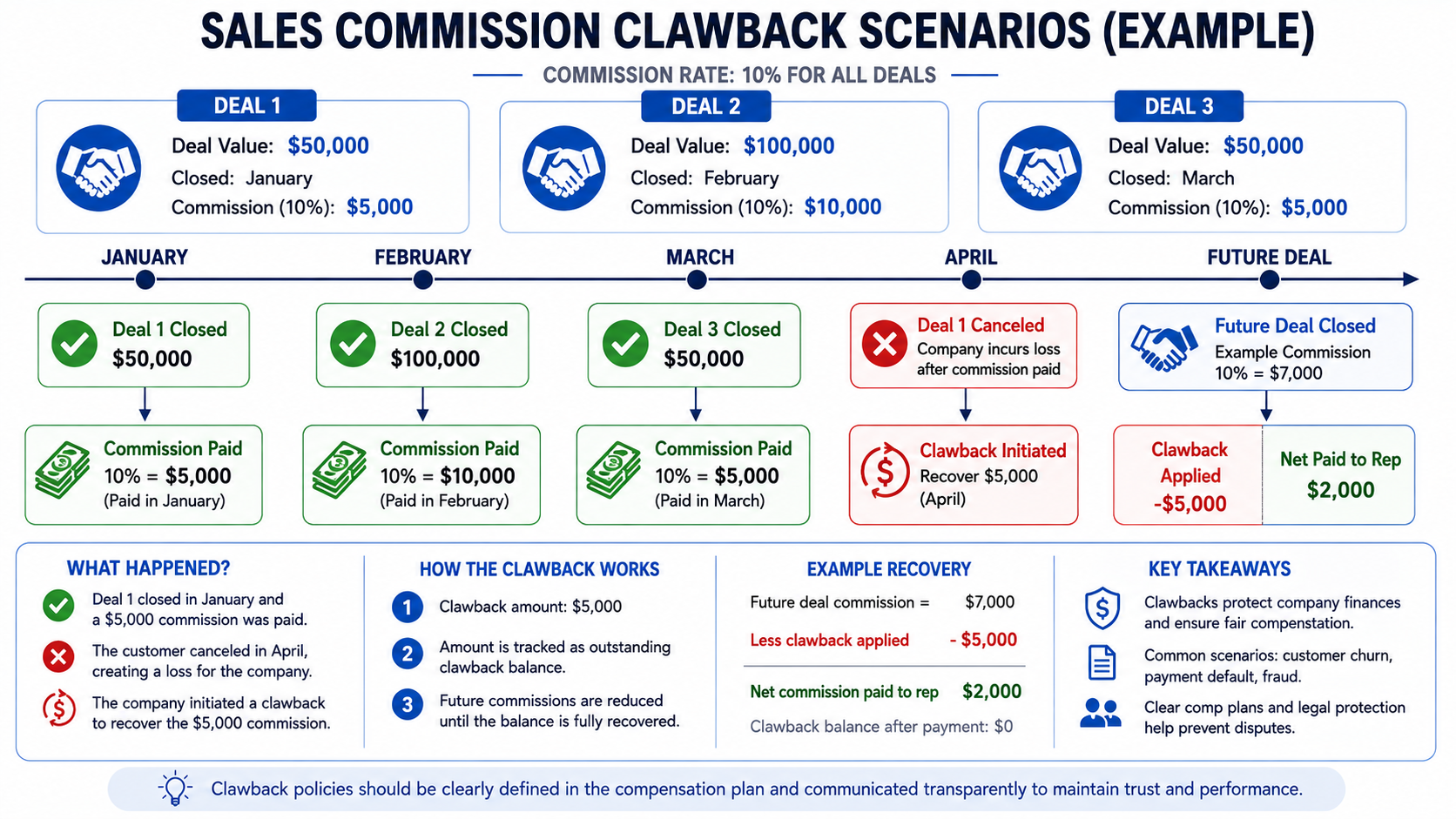
The example above is a clawback on a single canceled deal. In practice, clawbacks often come out of future commission payments, which makes the calculation a little more involved when a rep has several deals in play.
Say deal one is worth $50,000 and closes in January, deal two is worth $100,000 and closes in February, and deal three is worth $50,000 and closes in March. At a 10% commission rate, deal one generates a $5,000 commission payment.
If deal one is later canceled, the company can start a $5,000 clawback. Rather than asking the rep to repay that amount right away, many companies recover it from future commission earnings. If the rep earns $7,000 in commission on a later deal, for example, $5,000 may be deducted to settle the clawback, leaving $2,000 payable. Before deducting from future pay, check the state wage laws that apply, because some states restrict deductions from wages a rep has already earned.
This is why the clawback process needs to be written into the compensation plan. The policy should say which events trigger a clawback and how the amount is calculated and recovered. Clear rules help companies deal with customer churn, nonpayment or fraud without a dispute every time it happens.
Recommended reading: Choosing an ICM Solution: Variabl vs. Xactly
Types of sales commission clawbacks
Clawbacks can be structured in different ways depending on how a company pays commissions, recognizes revenue and manages financial risk. Whichever approach you choose should fit the broader sales compensation structure, and both sales reps and finance should understand how it works.
1. Exact payout clawback
An exact payout clawback requires the sales rep to return the same commission amount they originally received for a deal. If a customer cancels, fails to pay or otherwise triggers the clawback provision, the company recovers that exact amount.
For example, if a rep earns $2,000 in commission on a deal that later falls through, the company recovers the full $2,000. This keeps the clawback tied directly to the original payout, so the company isn’t left carrying commission expense for revenue it never realized.
2. Negative quota credit clawback
A negative quota credit clawback adjusts a sales rep’s quota attainment instead of directly recovering a commission that was already paid. If a deal is canceled or otherwise becomes ineligible, its value is removed from the rep’s credited sales for the relevant performance period. For example, if a rep received $50,000 in quota credit for a deal that later falls through, that $50,000 may be deducted from their attainment.
This can reduce future commission payouts, especially in tiered sales commission structures where payout rates rise as reps reach higher attainment levels. It keeps credited performance in line with the revenue the company actually keeps.
3. Partial clawback
A partial clawback lets a company recover only the portion of a commission tied to revenue it doesn’t receive. This is common when a customer fulfills part of a contract before canceling or reducing its commitment.
For example, if a customer pays for six months of a one-year subscription before canceling, the rep may keep the commission on the revenue the company received, and the rest is clawed back. This works well for recurring-revenue businesses because payouts stay closer to the revenue actually realized.
4. Conditional clawback
A conditional clawback applies only when specific conditions defined in the compensation plan are met. These conditions usually include events such as a customer canceling, failing to pay or terminating a contract within a defined clawback period.
For example, a company may require repayment only when a customer cancels within the first 90 days of a contract. Reps know exactly when a clawback can occur, and the company focuses recovery on deals that fail to meet its revenue or retention requirements.
5. Future period adjustment clawback
A future period adjustment clawback recovers the amount owed from commission earned in a later period rather than reducing the rep’s current payout or quota attainment. It’s about when the money is recovered rather than how much, so it can be combined with an exact or partial clawback.
For example, if a rep owes a $2,000 clawback, the company may deduct that amount from commissions earned the following month or quarter. This can make clawbacks easier to manage and may soften the immediate hit to a rep’s earnings.
6. Retroactive negative quota credit
A retroactive negative quota credit adjusts a sales rep’s attainment for the period in which the original deal was credited. Rather than applying the adjustment to the current period, the company recalculates prior performance as if the canceled or ineligible deal had never counted toward quota.
For example, if removing a deal drops a rep’s attainment into a lower tier, the company may need to recalculate the commission earned in that period and recover any overpayment. This method is harder to administer, but it keeps historical quota attainment and tiered commission calculations in line with the revenue the company actually realized.
Recommended reading: Is a Commission-Only Job Right for You?
Why do companies use a sales commission clawback provision?
Sales commission clawbacks help companies manage the gap between when a commission is paid and when the underlying revenue is fully realized. That gap is widest in businesses where customers pay over time, contracts can be canceled, or deals change after the initial sale.
Companies typically use clawback provisions to:
1. Protect against lost revenue
Companies often pay commissions before they’ve collected the full value of a contract, particularly in subscription and recurring-revenue businesses. If a customer later cancels, defaults on payment, reduces the scope of the agreement or otherwise fails to fulfill the contract, the company may be left with a commission expense tied to revenue it never receives.
A clawback provision gives the company a defined way to recover some or all of that payment. Commission costs stay in line with realized revenue, and deals that don’t perform as expected do less financial damage.
2. Keep incentives aligned with deal quality
Sales compensation should reward more than getting a contract signed. If reps are paid in full on deals that quickly cancel, go unpaid or were a poor fit from the start, the plan can end up encouraging behavior that causes problems later for finance, customer success and the business as a whole.
A clawback provision makes durable, qualified business worth more to the rep. When commission eligibility depends on clearly defined outcomes, reps have a reason to focus on customers who are likely to pay, stay and deliver the revenue the deal was expected to generate.
3. Improve compensation accuracy
Commission payments are usually calculated on the value of a deal at the time it closes. If that deal is later canceled, reduced or goes unpaid, the original payout no longer reflects the revenue the company actually earned.
A clawback provision gives companies a consistent way to correct those discrepancies. Adjusting commissions when deal value changes keeps payouts in line with actual performance and reduces the risk of overpaying on revenue that never fully materialized.
4. Reduce financial and reporting risk
Commission payments get hard to account for when the underlying deals are canceled, reduced or never fully collected. Without a defined process for handling those changes, companies can end up carrying commission expenses that no longer match the revenue associated with them.
A clear clawback policy gives finance and compensation teams a consistent way to handle these adjustments. It also documents when commissions should be recovered, how much should be adjusted, and how the changes show up in compensation records and financial reporting.
5. Set clearer expectations for sales reps
Clawbacks cause frustration fast when reps don’t understand why a commission was reduced or recovered. A clearly defined policy removes some of that uncertainty by setting out what can trigger an adjustment before a deal ever closes.
The compensation plan should spell out which events qualify for a clawback, how long a deal remains subject to one, how the amount is calculated, and how the adjustment will appear in future commission payments. When reps can see these rules, they understand how their earnings are determined, and there are fewer disputes when a clawback does happen.
Recommended reading: Pharmaceutical Sales Commission Structure Key Insights
Why do sales reps dislike sales commission clawbacks?
Reps often dislike clawbacks because they add uncertainty to pay they may already consider earned. A rep can close a deal, receive the commission, and then see part or all of it reversed weeks or months later because the customer canceled, stopped paying or changed the contract.
That’s especially frustrating when the reason for the clawback is outside the rep’s control. Implementation problems, billing issues, product limitations or poor post-sale support can all cause churn that has nothing to do with the quality of the original sale. When a clawback policy doesn’t account for those differences, reps may feel they’re being held financially responsible for outcomes they can’t influence.
Clawbacks also make earnings harder to predict. If future commission payments are reduced to recover past payouts, reps have less confidence in what they’ll actually take home from one period to the next. Over time, unclear or inconsistently applied rules lead to disputes and erode trust in the compensation plan, and the incentives lose their pull.
That’s why the structure of the policy matters. Clear eligibility rules, reasonable clawback windows, transparent calculations and well-defined exceptions protect the business without making reps feel that pay they’ve already earned is always at risk.
Recommended reading: The Best Way to Calculate Commission: Simple Steps and Examples
What is a clawback exception request?
A clawback exception request is when a sales rep asks the company to waive or modify a clawback that would otherwise apply under the compensation plan. These requests usually come up when the rep believes the lost deal resulted from circumstances outside their control, or when applying the standard policy would produce an unfair result.
Exception requests are hard because they force a choice between consistency and judgment. Waiving a clawback may be reasonable in some cases, but frequent or inconsistent exceptions weaken the compensation plan, set precedents and lead to arguments about how similar cases were handled.
For that reason, companies should set up a clear approval process for clawback exceptions. Document each request, review it against defined criteria, and route it to the right approvers in compensation, finance, sales or the executive team. The aim is to leave room for legitimate exceptions without turning the clawback policy into a case-by-case negotiation.
Recommended reading: The Definitive Guide to the Commission-Only Sales Position
What frequent clawbacks say about your comp plan
Clawbacks tend to get treated as a small administrative detail in a sales compensation plan, but they can reveal a lot about how well the broader compensation program is designed. If a company is constantly processing clawbacks, fielding exception requests or settling arguments about who should bear the cost of a failed deal, the policy itself may not be the only thing worth examining.
Frequent clawbacks can point to problems elsewhere in the sales process. Qualification standards may be too loose, commission timing may not match how the business collects revenue, or sales and customer success may have different definitions of a healthy customer. Looking at clawback data over time helps companies spot those patterns instead of treating every reversal as an isolated compensation issue.
The goal shouldn’t be to eliminate clawbacks at all costs. Aim for a policy you rarely need to debate. When the rules reflect how the business actually earns revenue, and reps are only held responsible for outcomes they can reasonably influence, clawbacks become easier to administer and easier for the sales team to accept.