


Sales commissions are a big part of how most companies pay and motivate their sales teams, but deciding what to pay takes more than picking a number. Companies need to consider both the commission rate and the structure of the plan so that compensation fits the role and the goals of the business.
Knowing what standard sales commission rates and structures look like gives you a useful starting point. Below are common rates and plan structures by role and by industry, along with the factors to weigh when you build or evaluate a plan that pays sales commission.
What is a standard sales commission?
A standard sales commission is the amount or percentage of a sale that a salesperson earns as variable compensation for generating revenue. The term suggests there is a single standard rate, but commission rates vary considerably by company, industry, sales role, and the type of product or service being sold.
Sales commissions are often calculated as a percentage of revenue or gross profit, although some companies use flat-rate payouts or other performance-based formulas. For example, one salesperson might earn 8% of the revenue they generate, while another company pays a fixed amount for each new customer or product sold.
What counts as a standard sales commission also depends on the broader commission pay structure. A role with a higher base salary may have a smaller portion of compensation tied to commission, while a commission-heavy or commission-only role may offer higher earning potential on each sale.
Recommended reading: The Top Sales Compensation Consulting Firms in the United States
What is a standard sales commission rate?
There is no single standard sales commission rate that applies across every company or sales role. Commission rates vary with industry, deal size, profit margins, sales cycle, and how much of a salesperson’s total compensation comes from variable pay.
For many sales roles, commission rates fall somewhere between 5% and 20% of the value of a sale, although rates can fall outside this range depending on how the plan is structured. A company selling high-value products with relatively low margins, for example, may offer a lower percentage than a business with higher margins or smaller deal sizes. Commission-only positions may also carry higher rates because the salesperson receives little or no guaranteed base salary.
The percentage on its own also doesn’t tell you how competitive or effective a commission plan is. A 10% commission on revenue produces a very different payout than 10% on gross profit, and a flat 10% rate works differently from a plan that raises the rate as a rep reaches or exceeds quota. Base salary, quota, on-target earnings (OTE), accelerators, thresholds, and other plan components all affect how much a salesperson can earn.
That’s why standard sales commission rates are most useful as benchmarks rather than rules. Compare your rates with similar roles and industries, but set the final rate based on your own sales economics and the earnings opportunity you want to offer.
Recommended reading: Is a Commission-Only Job Right for You?
How to calculate standard sales commission rates
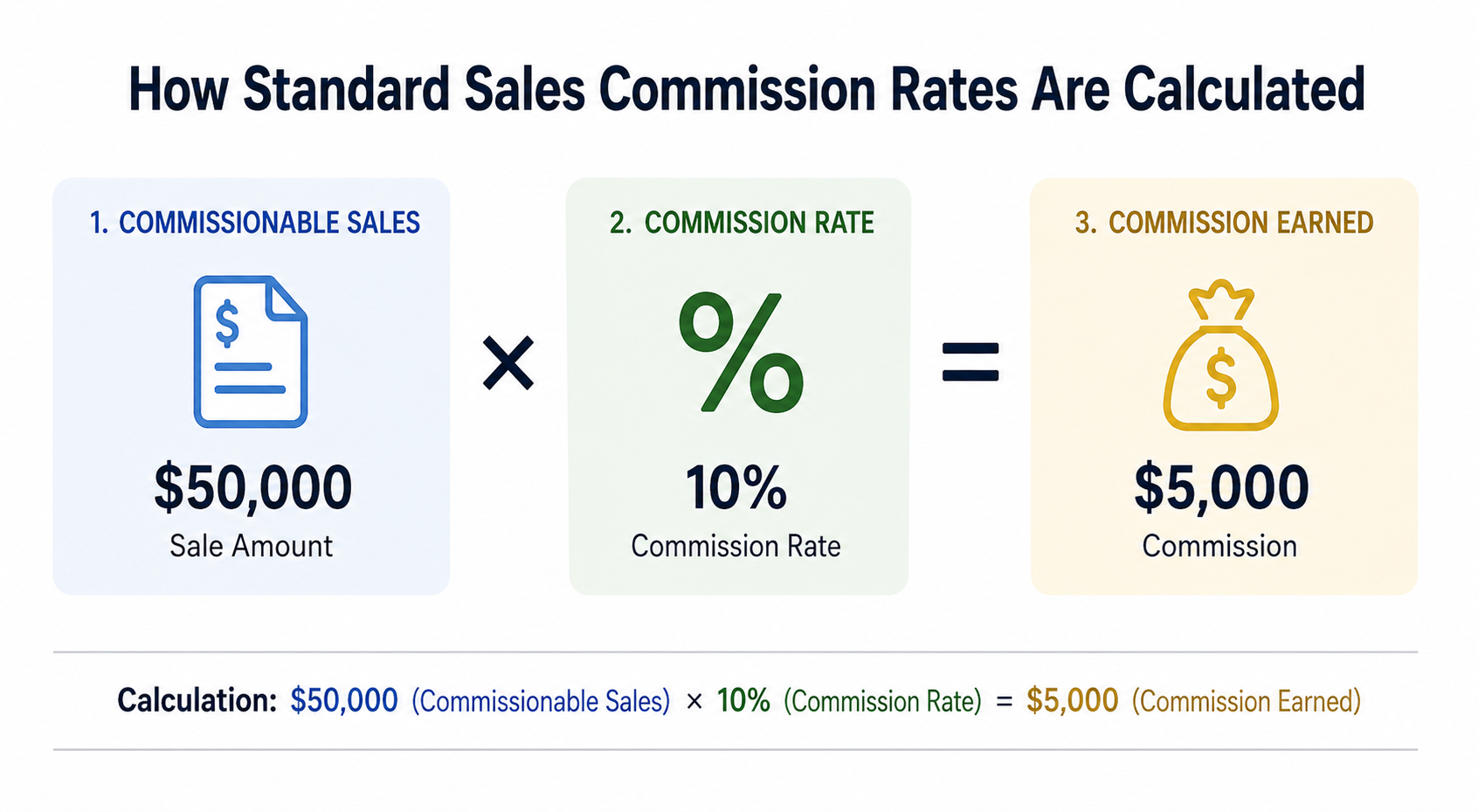
Sales commissions are typically calculated by multiplying the amount of commissionable sales by the applicable commission rate. For example, if a rep closes a $50,000 sale and earns a 10% commission, their commission is $5,000.
The calculation gets more complex depending on the commission structure. Companies may calculate commissions on revenue, gross profit, units sold, or another performance measure. Plans may also use different rates based on quota attainment, sales volume, or other thresholds, so the rate applied to each sale can change as a rep moves through the compensation period.
Recommended reading: Uncapped Commission: Key Advantages and Potential Pitfalls to Consider
Standard sales commission rates by role
Standard sales commission rates vary considerably by role because different members of a sales team have different levels of influence over revenue. Roles directly responsible for closing new business usually have more compensation tied to sales performance. Roles focused on prospecting, customer management, or team leadership often have a larger base salary and different incentive measures.
Because of these differences, commission percentage alone isn’t always the best way to compare compensation across sales roles. Pay mix, the share of on-target earnings that comes from base salary versus variable compensation, is another useful benchmark.
Account executives
Account executives typically have one of the strongest connections between individual sales performance and variable compensation. According to The Bridge Group’s 2026 AE Models, Motions & Metrics research, the median B2B account executive earns $200,000 in on-target earnings against a median annual quota of $960,000. The study included 158 B2B companies.
Earlier research from The Bridge Group found a median 53:47 base-to-variable pay mix for SaaS AEs, meaning nearly half of target compensation was tied to variable earnings. Commission rates can then be set based on the amount of variable compensation available at quota and the revenue or ACV the rep is expected to generate.
Sales development representatives
SDRs and BDRs are less likely to earn a standard percentage of the revenue from each deal, because their main job is generating qualified pipeline rather than closing business. Their variable compensation may instead be tied to qualified meetings, opportunities, pipeline, or a combination of performance measures.
The Bridge Group’s 2025 Sales Development benchmark study, based on 351 B2B companies, found a median SDR OTE of $80,000, made up of a $55,000 base salary and $25,000 in variable compensation. That is roughly a 68:32 base-to-variable pay mix.
Account managers and existing-customer sellers
Account managers and other sellers responsible for existing customers often have more guaranteed compensation than new-business sellers. Their incentives may be tied to renewals, expansion revenue, retention, or other customer revenue goals rather than a single commission rate on every sale.
WorldatWork’s Sales Compensation Programs & Practices study found that field sellers focused on current customers had an average target pay mix of 59% base salary and 41% variable compensation. By comparison, field new-account sellers had a 54:46 mix.
Sales managers
Sales managers typically have more of their compensation guaranteed through base salary, because their performance depends on the results of a whole team rather than the deals they personally close. Their variable compensation can be tied to team revenue, quota attainment, or other broader sales objectives.
WorldatWork found that field first-line sales managers had an average target pay mix of 66% base salary and 34% variable compensation. Inside first-line sales managers had the same 66:34 split.
Role-based benchmarks are most useful for deciding how much of a role’s sales compensation should be tied to performance, and which results the employee can reasonably influence. From there, you can set the commission rate or incentive formula based on the role’s target earnings, quota, responsibilities, and contribution to revenue.
Recommended reading: The Definitive Guide to the Commission-Only Sales Position
Standard sales commission rates by industry
Sales commission rates vary significantly by industry because companies have different margins, deal sizes, sales cycles, and revenue models. What the rate is applied to also matters. A percentage of annual contract value in SaaS isn’t directly comparable to a percentage of premium in insurance or a percentage of the sale price in real estate.
SaaS and software
SaaS companies commonly calculate commissions on annual contract value (ACV), annual recurring revenue (ARR), or another measure of new business booked by a salesperson.
A common rule of thumb puts commissions for SaaS account executives at around 10% of ACV at quota, although rates vary with deal size and the economics of the sales model. The Bridge Group’s AE benchmark research has more data on AE quotas, on-target earnings, and sales productivity that you can use when setting a rate.
Manufacturing
Manufacturing commission rates vary depending on whether the salesperson is an employee or an independent manufacturer’s representative, the type of customer, and whether commissions are calculated on revenue or gross profit.
The Manufacturers’ Agents National Association surveyed 402 manufacturers’ representatives and found average commission rates of 6% for sales to original equipment manufacturers (OEMs), 7% for sales to distributors, and 11% for sales to end users. Reported ranges ran from 5% to 14% depending on customer type.
Insurance
Insurance commissions are usually calculated as a percentage of the premium on a policy, but rates vary considerably by product and between new business and renewals.
InSifter’s 2026 insurance commission benchmark data, based on 180 agent-reported rates across 70 carriers, found new-business commissions of about 10% to 15% for personal lines and 10% to 20% for commercial lines. Renewal commissions generally ran two to four percentage points below new-business rates.
Real estate
Real estate commissions are usually calculated as a percentage of a property’s sale price rather than against a quota or recurring revenue target. The total commission on a transaction may also be divided between the brokerages and agents representing the buyer and the seller.
Real estate commissions are negotiable and vary by market, property, brokerage, and transaction, so no single percentage is a required industry rate. Total residential commissions have typically been around 5% to 6% of the sale price, before that amount is divided among the parties involved.
Industry benchmarks show what other companies may be paying, but they don’t decide what your company should pay. The right rate depends on what the commission is calculated against, the margins on the sale, expected sales volume, the role’s pay mix, and your broader compensation strategy.
Recommended reading: Do Sales Engineers Make Commission?
What your commission data says about your sales team
A commission plan can also tell a company a lot about the health of its sales organization. When reps consistently struggle to understand their earnings, managers regularly make exceptions, or payouts don’t match the outcomes the business expected, the problem may go beyond the commission rate. Those patterns can point to unclear goals, unrealistic quotas, inconsistent sales processes, or gaps in how performance is measured.
Treat commission data as another source of information about how the sales organization is operating. Looking at attainment, payouts, exceptions, and earnings over time helps leaders see where expectations and actual performance don’t line up, and make better decisions about the broader sales strategy.