



Sales commission plans often need to account for different levels of performance rather than paying the same rate on every sale. A tiered commission structure gives companies a way to do that by adjusting commission rates as reps reach defined performance thresholds.
Depending on how a sales commission plan is designed, tiers can be used to reward incremental performance, create stronger incentives around specific goals, or better align commission payouts with the value of additional sales. They can also introduce more complexity, particularly when reps need to understand when new rates take effect and how commissions are calculated across different tiers.
In this guide, we’ll explain how tiered commission structures work, look at common approaches and examples, and walk through the decisions involved in designing and calculating them. We’ll also cover the advantages and potential drawbacks of using tiers and the best practices companies should consider when incorporating them into a sales compensation plan.
What is a tiered commission structure?
Let’s start with the basics. A tiered commission structure is a sales compensation model in which the commission rate changes when a sales rep reaches predetermined performance thresholds.
Instead of earning the same commission rate on every sale, reps move through a series of tiers based on metrics such as revenue generated, quota attainment, units sold, or another measure defined by the company. Each tier is associated with a specific commission rate or payout.
Recommended reading: The Top Sales Compensation Consulting Firms in the United States.
How does a tiered commission structure work?
A tiered commission structure divides sales performance into defined ranges, with a different commission rate assigned to each range. As a rep reaches a new threshold, their commission rate changes according to the rules of the plan. Those thresholds might be based on revenue, quota attainment, units sold, or another performance metric.
Companies also need to determine how the new rate will apply once a rep crosses a threshold. In an incremental tiered structure, each rate applies only to the sales that fall within that specific tier. Other plans may apply the new rate to all eligible sales once the threshold is reached. This distinction can have a significant effect on commission payouts, so the calculation method should be clearly defined when the plan is designed and communicated to reps.
Recommended reading: Comparing ICM Solutions: Variabl vs. Xactly.
Examples of Tiered Sales Commission Structures
Tiered sales commission plans can be structured in several ways depending on what a company sells, how performance is measured, and the behaviors the plan is intended to encourage. The following examples show some of the most common ways companies can apply tiers within a sales commission plan.
Revenue-Based Commission Tiers
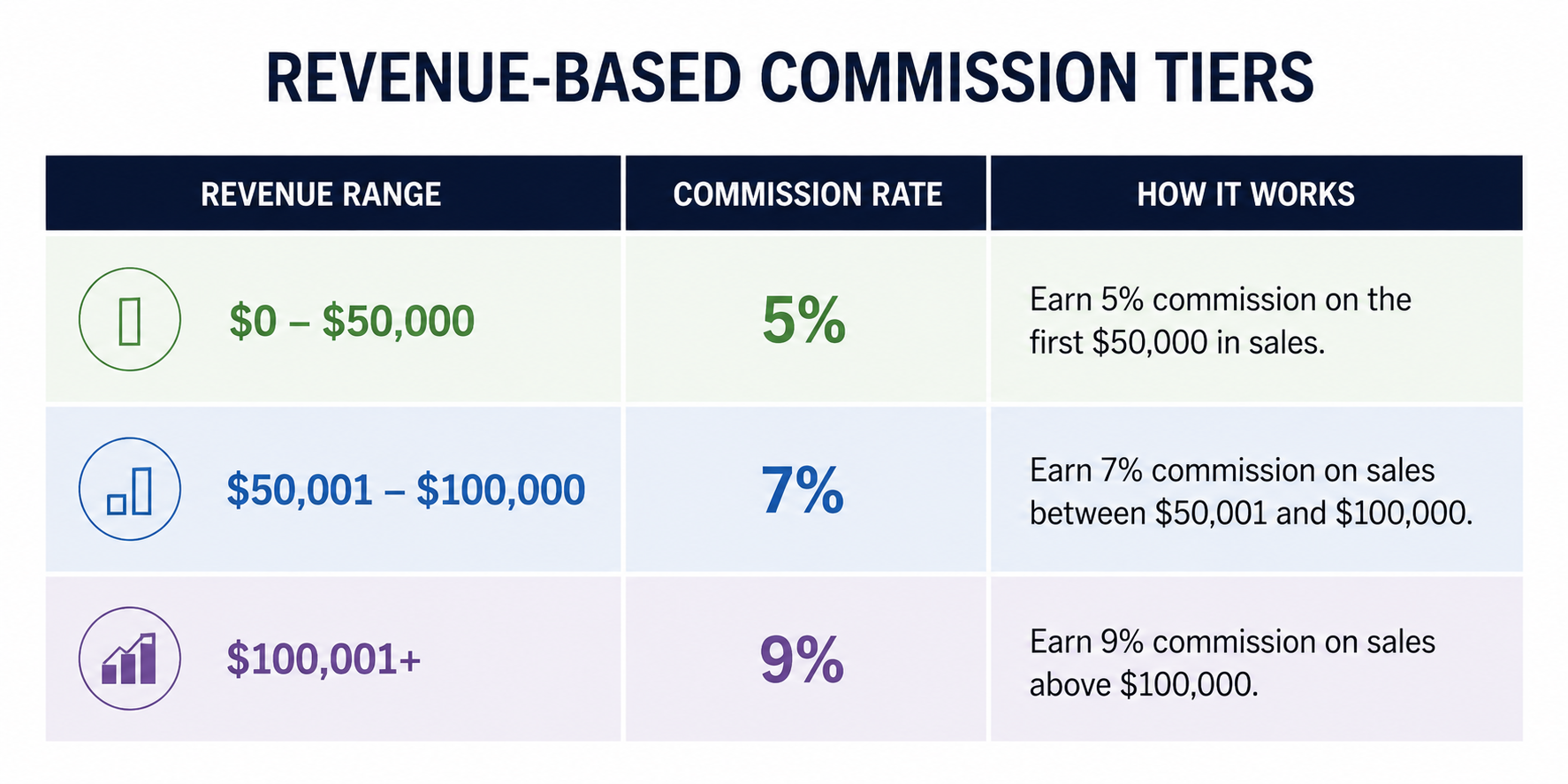
A company can create commission tiers based on the total revenue a rep generates during a given period. For example, a rep might earn a 5% commission on their first $50,000 in sales, 7% on sales between $50,001 and $100,000, and 9% on sales above $100,000. As the rep moves into each new tier, the higher rate applies to the revenue earned within that tier. This type of commission pay structure creates a direct relationship between incremental revenue and commission earnings.
Quota Attainment Tiers
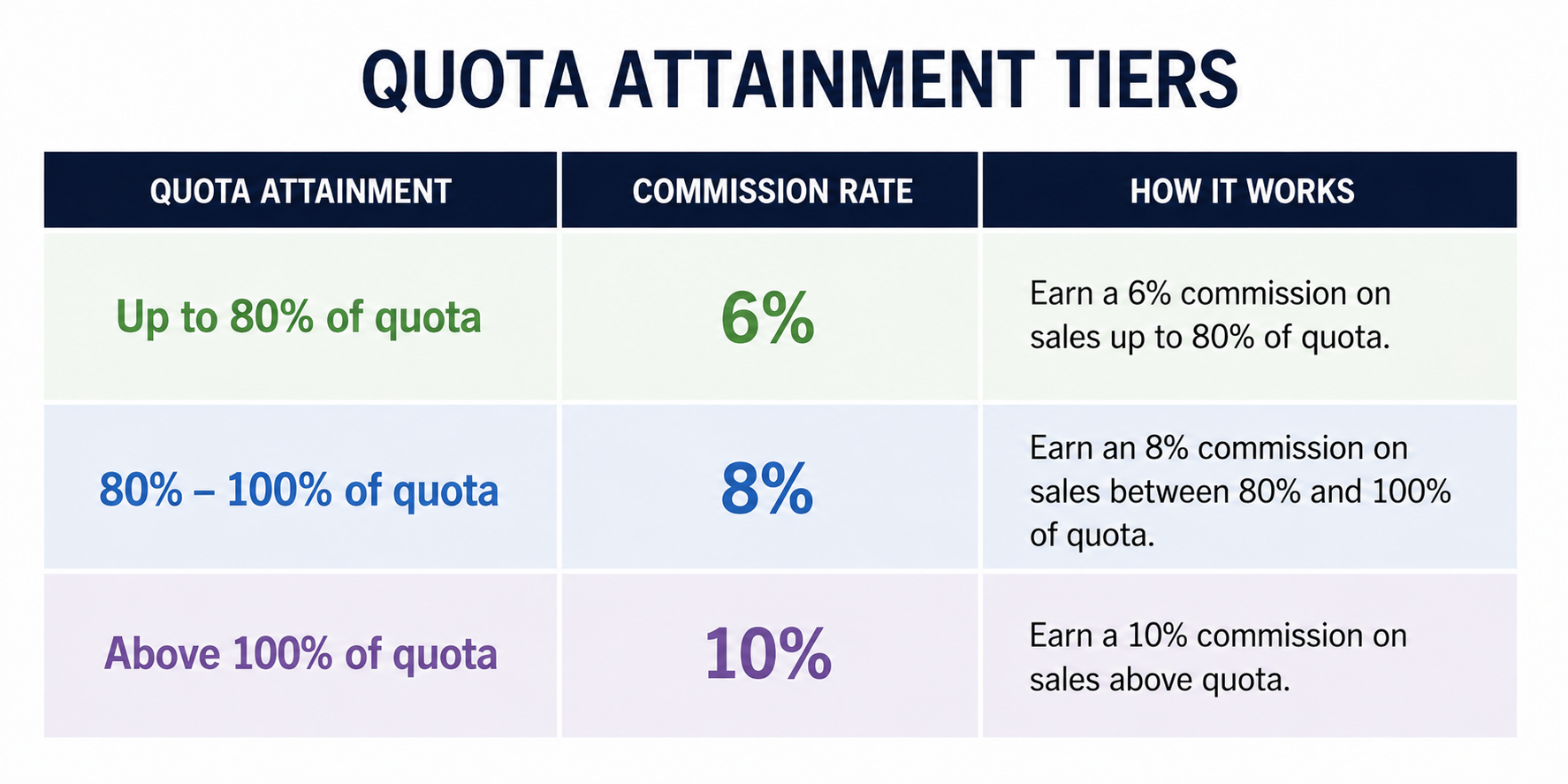
Tiered commissions can also be based on the percentage of quota a rep achieves. A company might pay a 6% commission up to 80% of quota, increase the rate to 8% between 80% and 100%, and pay 10% on sales above quota. This structure allows companies to establish different payout rates around important performance thresholds and use higher rates to reward reps who reach or exceed their targets.
Unit-Based Commission Tiers
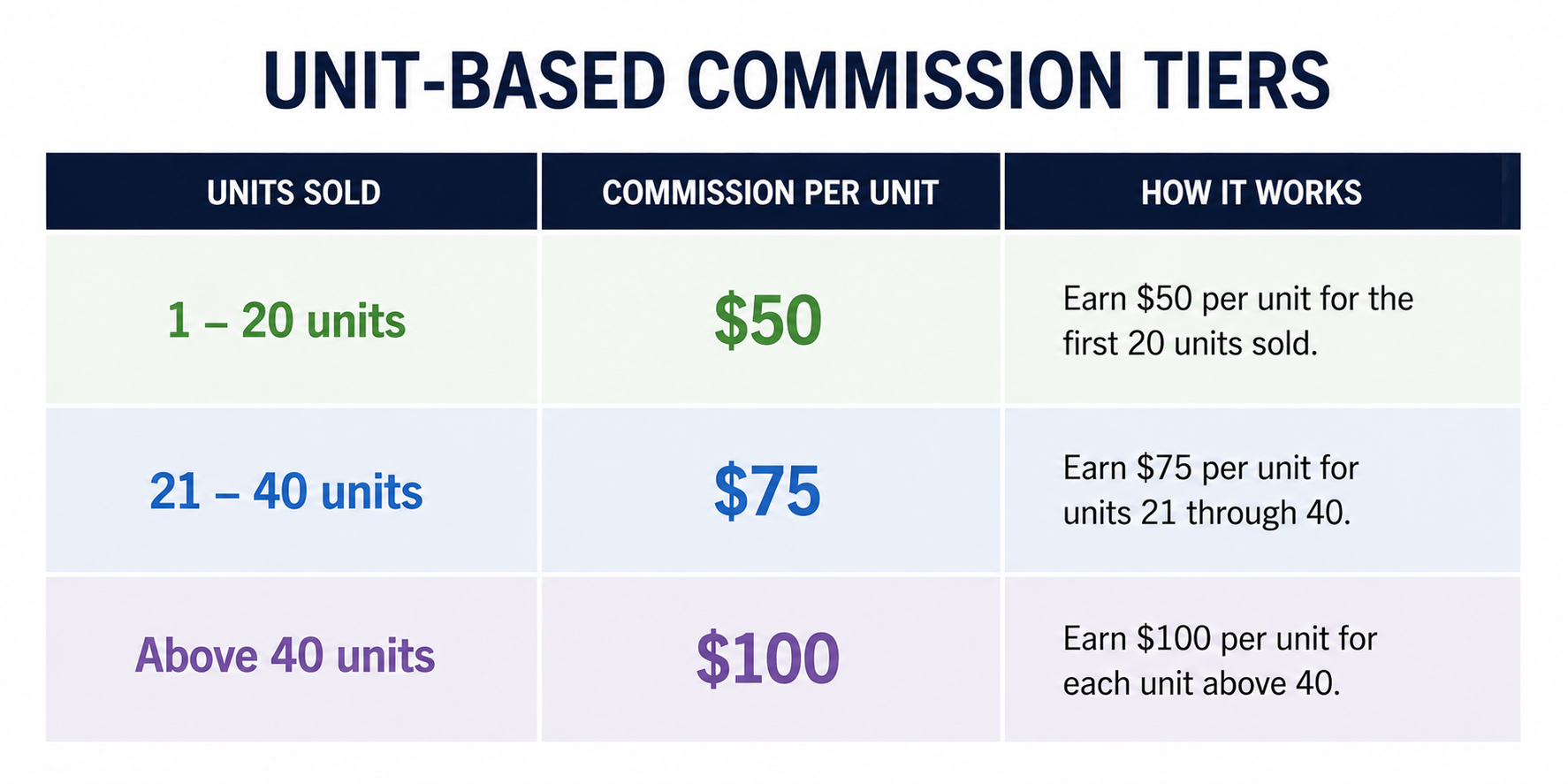
For businesses that measure sales performance by volume, tiers can be tied to the number of products, subscriptions, or other units sold. A rep might earn $50 per unit for the first 20 units sold, $75 per unit for units 21 through 40, and $100 for each unit above 40. This type of tiered commission plan can be useful when individual sales have relatively consistent values and the company wants to encourage greater sales volume.
Recommended reading: Is a Commission-Only Job Right For You?
How to Calculate Tiered Commissions
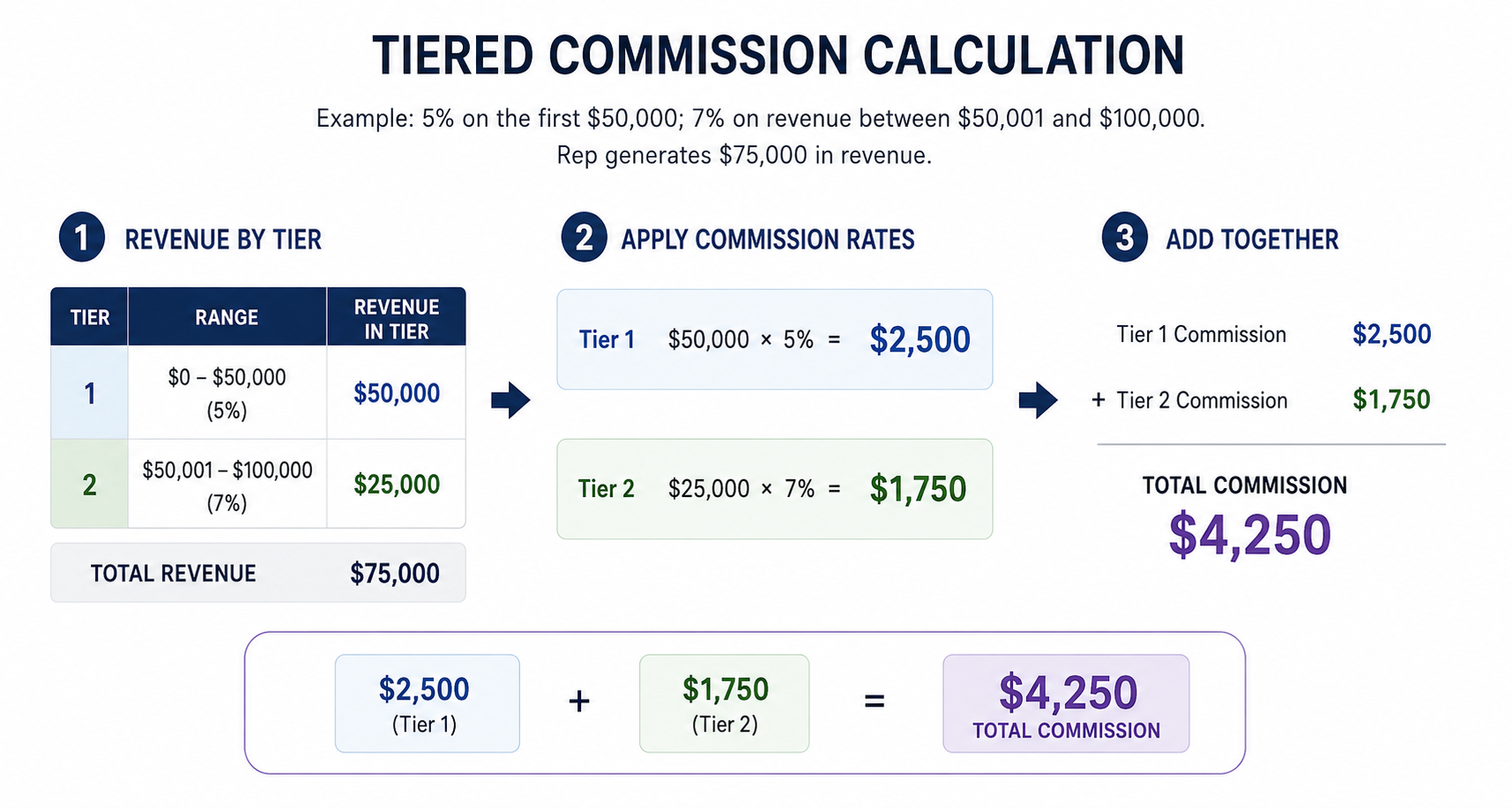
To calculate commissions in this type of tiered structure, first determine how much of a rep’s sales or performance falls within each tier, then apply the corresponding commission rate to that amount.
For example, if a plan pays 5% on the first $50,000 in revenue and 7% on revenue between $50,001 and $100,000, a rep who generates $75,000 would earn 5% on the first $50,000 and 7% on the remaining $25,000. The commission earned within each tier is then added together to determine the rep’s total payout.
Recommended reading: The Definitive Guide to the Commission Only Sales Position.
When should a company or team use a tiered commission structure?
A tiered commission structure can be a good fit when a company wants to create stronger incentives around specific levels of sales performance. Because commission rates can increase at predetermined thresholds, companies can use tiers to place additional rewards around the results that matter most, whether that means reaching quota, exceeding a revenue target, increasing sales volume, or hitting another measurable goal.
Tiered structures can be particularly useful when there’s meaningful value in incremental performance. If additional revenue becomes more valuable after certain targets are reached, for example, a company may be comfortable paying a higher commission rate on those sales. Tiers can also help differentiate compensation between average, strong, and exceptional performance rather than rewarding every level of production at the same rate.
However, adding tiers also adds complexity to a compensation plan. Companies should have clearly defined performance metrics, reliable commission data, and enough visibility into potential payouts to understand how different thresholds will affect compensation costs. If the underlying sales motion is relatively simple or additional tiers don’t serve a specific business purpose, a straightforward commission structure may be easier for both the company and its sales reps to manage.
Recommended reading: Target Compensation: Key Insights & Benefits Explained.
Best Practices for Managing a Tiered Sales Commission Plan
Tiered compensation plans introduce additional variables that companies need to account for as reps move through different levels of performance. Managing those plans effectively requires more than setting the initial thresholds and commission rates. The following best practices can help companies maintain a tiered plan that remains accurate, understandable, and manageable over time.
Keep Tiers Simple and Distinct
Each additional tier makes a compensation plan more difficult for reps to understand and for compensation teams to administer. Use enough tiers to create meaningful differences in how performance is rewarded, but avoid adding thresholds that don’t serve a clear purpose.
The difference between tiers should also be significant enough to influence behavior. If thresholds are too close together or rate increases are too small to matter, the additional complexity may not provide much value.
Set Meaningful Performance Thresholds
Tier thresholds should reflect realistic levels of sales performance and support the goals of the compensation plan. Historical attainment data can help teams understand how reps are likely to perform against proposed thresholds and how frequently they’re likely to enter each tier.
Before implementing a plan, model different performance scenarios to see how the structure behaves at low, expected, and exceptional levels of attainment. This can help identify thresholds that are too easy or difficult to reach and reveal unexpected changes in commission expense.
Clearly Define How Each Tier Is Calculated
Reps should be able to understand what happens to their commission when they cross a threshold. Plan documentation should specify which performance metric determines tier attainment, the rate associated with each tier, and whether a higher rate applies only to the sales within that tier or changes the rate applied to other eligible sales.
Clear calculation rules also make it easier for compensation teams to administer the plan consistently. Ambiguity around tier transitions can lead to payout disputes, manual adjustments, and different interpretations of the same compensation plan.
Give Reps Visibility Into Tier Progress
Reps should know which tier they’re currently in, how close they are to the next threshold, and how reaching that threshold could affect their earnings. Providing this information throughout the performance period makes the incentive easier to understand and gives reps a clearer connection between additional performance and potential compensation.
Visibility becomes particularly important as plans get more complex. If reps have to calculate their own tier attainment or wait until a commission statement is issued to understand their earnings, some of the motivational value of the structure can be lost.
Model Commission Costs Before Launch
Higher commission rates can create meaningful changes in compensation expense, particularly when multiple reps reach upper tiers at the same time. Companies should model expected payouts across a range of attainment levels before finalizing thresholds and rates.
Scenario modeling can also uncover unintended outcomes within the plan. Looking at what a rep would earn at several points below, at, and above each threshold gives compensation teams a better understanding of how the plan will behave before real payouts are involved.
Review Tier Performance Regularly
A tiered commission plan shouldn’t remain unchanged simply because the underlying calculations are working correctly. Companies should periodically review attainment distribution, commission expense, rep behavior, and how frequently each tier is reached to determine whether the structure is producing the intended results.
If nearly every rep reaches the highest tier, almost nobody progresses beyond the first, or certain thresholds consistently produce unexpected behavior, the plan may need adjustment. Reviewing actual performance data gives teams a stronger basis for making those changes during future planning cycles.
Recommended reading: Understanding Residual Commission Benefits & Effective Strategies.
Final Thoughts
The effectiveness of a tiered commission structure ultimately depends on whether the added complexity earns its place in the compensation plan. Every threshold and rate change should have a clear reason for being there and create an outcome the company is comfortable rewarding.
As the business evolves, that reasoning may change. Sales performance, company priorities, and compensation budgets rarely stay static, so tiered structures should be treated as something companies can evaluate and refine over time rather than a set of thresholds that remain in place indefinitely.